Opsin raises $21M to secure the agentic enterprise.
Hear from our founders →



Most AI alerts still treat AI systems like strange endpoints: a user pasted sensitive data, a file moved through a model, a prompt looked risky. Those signals matter, but AI systems now retrieve data, call tools, and act through agents on people's behalf.
As a result, AI Detection and Response (AIDR) must evolve to also capture whether the user, the agent, the data, and the action fit the agent's intended use. That means explaining the relationship between them: who acted, what the agent was meant to do, what data moved, and whether the activity fits the agent's intended audience and purpose.
An alert that says sensitive data appeared in an AI workflow is useful, but incomplete. Reviewers need to know why the data appeared, whether the user had a business reason to see it, whether an agent made the exposure possible, and what should happen next.
Posture shows potential exposure. AIDR handles observed behavior. Many AI incidents begin with normal-looking pieces: a valid user account, an approved AI tool, a file the user can technically reach, or an agent shared more broadly than intended. The risk appears when those pieces combine in a way that does not match the business context.
AIDR should reduce that translation burden. Instead of asking an analyst to reconstruct the chain manually, the alert should bring the intent chain forward: actor, agent, data, action, and reason.
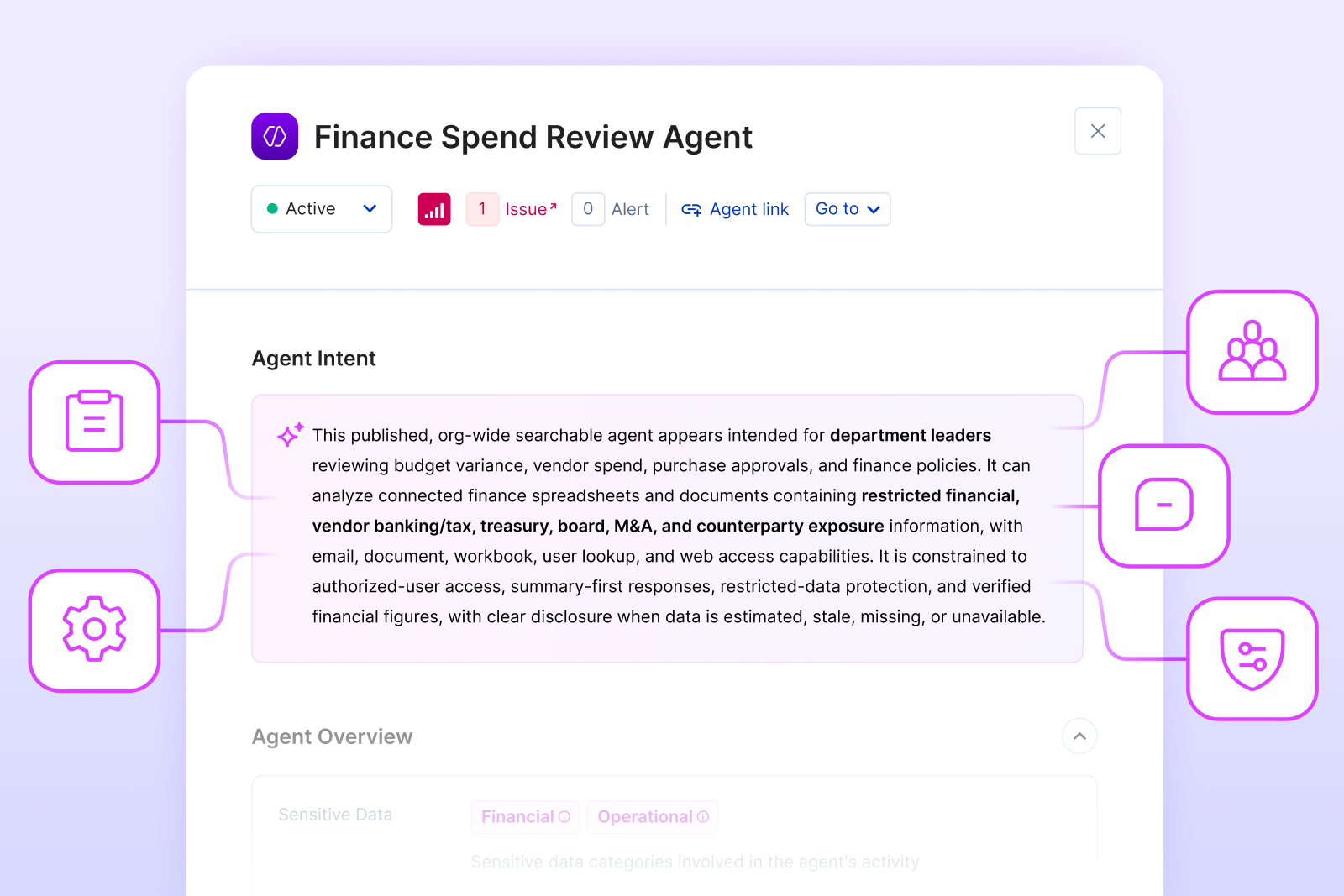
Agent Intent gives security teams a way to describe what an agent appears built to do before runtime behavior teaches the monitoring system the wrong lesson. It captures intended audience, business function, topic, actions, data access, and declared constraints from the agent's evidence.
That context is essential because the same capability can be appropriate in one agent and dangerous in another. A finance forecasting assistant may need planning spreadsheets. A public support agent with the same access needs review. An HR benefits assistant may answer employee policy questions. If it starts interacting with compensation datasets or external messaging tools, the question is whether that behavior still fits the agent's purpose.
Agent Behavior Baselining extends that idea over time. AIDR 2.0 carries it into alerting and response, telling reviewers when the relationship between the actor, the agent, the data, and the action no longer fits the agent's intended use.
The clearest way to see the next evolution of AIDR is through detections that do more than match a prompt pattern. They assess whether observed AI activity makes sense in the organization.
Unauthorized agent access asks whether a human actor has a plausible business reason to use a given AI agent. The signal is not just the agent's sharing setting. A broadly shared agent may be misconfigured, and an invite-only agent may still have the wrong audience. The stronger question is whether the agent's purpose, tools, data sources, and intended audience line up with the actor's business function.
A sales representative using a CRM deal assistant is probably normal. A marketing coordinator using a legal contract assistant connected to legal repositories may not be. A software engineer using an HR compensation agent with content-classified salary data is a stronger signal than a generic policy assistant.
AI-retrieved files role mismatch looks at a different exposure path: the AI assistant retrieved a sensitive file that was broadly accessible, but the user's business function does not appear to justify access to that content. The user may not have uploaded anything or bypassed an access control. The assistant simply found and returned sensitive material that was available somewhere in the enterprise environment.
The useful part of the signal is intent context, especially the agent's intended audience and the user's business function. A finance analyst seeing financial reports may be normal. An HR intern seeing a customer pipeline workbook may not be. Broad administrative responsibility can justify many categories of access, while application license groups should not be mistaken for business authorization. The next generation of AIDR capabilities has to understand those differences or it will produce noise instead of findings.

|
Actor
What do we know about the person’s job title, department, directory roles, and meaningful groups?
|

|
Agent
What was the agent intended to do, who was it meant to serve, and what tools or data sources can it reach?
|

|
Data
What sensitive domain or data category was involved, and was that classification based on content or only metadata?
|

|
Action
What did the AI system retrieve, expose, send, modify, or enable in the workflow?
|
This model also explains why conservative alerting matters. Missing proof of authorization is not enough. A good AIDR signal should be able to name the mismatch in plain language, such as a user receiving a sensitive file from an unrelated domain, or an agent meant for a narrow audience being used outside that audience.
That is how AIDR becomes useful after the alert fires. The reviewer should not see only a severity label. They should see the reasoning, related issues, affected agent or file, and activity that triggered review.
Response is where AIDR separates itself from posture management. If the finding is an intent mismatch, the next step may be to restrict file sharing, update group membership, educate the user, or confirm a legitimate exception. If the finding is unauthorized agent access, the next step may be to review agent sharing, narrow the intended audience, remove a sensitive data source, or resolve related agent issues.
The important point is that the alert should point to a fix. AIDR is not only about detecting intentional misuse, italso needs to catch unintentional misuse: the overbroad agent, the file shared too widely, the normal question that returned data the user should not have seen, or the team that copied an agent into a wider audience without realizing what it could reach.
Agent Intent explains what the agent is for. Agent Behavior Baselining shows whether behavior still fits that intent. The next evolution of AIDR turns those ideas into response-ready alerts when people, agents, and data no longer line up.

The next stage of AI Detection and Response needs to encompass alerts that use agent intent, activity, data, and identity context to explain why an AI interaction may be risky and what should be reviewed.
AI posture management evaluates what could be risky in an AI environment. AIDR focuses on observed AI activity and the response path after a risky interaction is detected.
Agents can retrieve data, call tools, and act on behalf of people. AIDR has to evaluate whether the person, agent, data, and action fit the agent's intended use.
Unauthorized agent access flags cases where a user appears to use an AI agent outside its intended audience or business purpose, based on the actor's identity, the agent's purpose, its tools, and the data it can retrieve.
AI-retrieved files role mismatch flags cases where an AI assistant retrieves sensitive files for a user whose business function does not appear to justify access to that content.
Security teams should review the activity, validate the intent mismatch, and remediate the underlying cause. That may mean restricting file access, adjusting group membership, narrowing agent sharing, removing data sources, resolving related issues, or educating the user.
Most AI alerts still treat AI systems like strange endpoints: a user pasted sensitive data, a file moved through a model, a prompt looked risky. Those signals matter, but AI systems now retrieve data, call tools, and act through agents on people's behalf.
As a result, AI Detection and Response (AIDR) must evolve to also capture whether the user, the agent, the data, and the action fit the agent's intended use. That means explaining the relationship between them: who acted, what the agent was meant to do, what data moved, and whether the activity fits the agent's intended audience and purpose.
An alert that says sensitive data appeared in an AI workflow is useful, but incomplete. Reviewers need to know why the data appeared, whether the user had a business reason to see it, whether an agent made the exposure possible, and what should happen next.
Posture shows potential exposure. AIDR handles observed behavior. Many AI incidents begin with normal-looking pieces: a valid user account, an approved AI tool, a file the user can technically reach, or an agent shared more broadly than intended. The risk appears when those pieces combine in a way that does not match the business context.
AIDR should reduce that translation burden. Instead of asking an analyst to reconstruct the chain manually, the alert should bring the intent chain forward: actor, agent, data, action, and reason.
Agent Intent gives security teams a way to describe what an agent appears built to do before runtime behavior teaches the monitoring system the wrong lesson. It captures intended audience, business function, topic, actions, data access, and declared constraints from the agent's evidence.
That context is essential because the same capability can be appropriate in one agent and dangerous in another. A finance forecasting assistant may need planning spreadsheets. A public support agent with the same access needs review. An HR benefits assistant may answer employee policy questions. If it starts interacting with compensation datasets or external messaging tools, the question is whether that behavior still fits the agent's purpose.
Agent Behavior Baselining extends that idea over time. AIDR 2.0 carries it into alerting and response, telling reviewers when the relationship between the actor, the agent, the data, and the action no longer fits the agent's intended use.
The clearest way to see the next evolution of AIDR is through detections that do more than match a prompt pattern. They assess whether observed AI activity makes sense in the organization.
Unauthorized agent access asks whether a human actor has a plausible business reason to use a given AI agent. The signal is not just the agent's sharing setting. A broadly shared agent may be misconfigured, and an invite-only agent may still have the wrong audience. The stronger question is whether the agent's purpose, tools, data sources, and intended audience line up with the actor's business function.
A sales representative using a CRM deal assistant is probably normal. A marketing coordinator using a legal contract assistant connected to legal repositories may not be. A software engineer using an HR compensation agent with content-classified salary data is a stronger signal than a generic policy assistant.
AI-retrieved files role mismatch looks at a different exposure path: the AI assistant retrieved a sensitive file that was broadly accessible, but the user's business function does not appear to justify access to that content. The user may not have uploaded anything or bypassed an access control. The assistant simply found and returned sensitive material that was available somewhere in the enterprise environment.
The useful part of the signal is intent context, especially the agent's intended audience and the user's business function. A finance analyst seeing financial reports may be normal. An HR intern seeing a customer pipeline workbook may not be. Broad administrative responsibility can justify many categories of access, while application license groups should not be mistaken for business authorization. The next generation of AIDR capabilities has to understand those differences or it will produce noise instead of findings.
|
|
Actor
What do we know about the person’s job title, department, directory roles, and meaningful groups?
|
|
|
Agent
What was the agent intended to do, who was it meant to serve, and what tools or data sources can it reach?
|
|
|
Data
What sensitive domain or data category was involved, and was that classification based on content or only metadata?
|
|
|
Action
What did the AI system retrieve, expose, send, modify, or enable in the workflow?
|
This model also explains why conservative alerting matters. Missing proof of authorization is not enough. A good AIDR signal should be able to name the mismatch in plain language, such as a user receiving a sensitive file from an unrelated domain, or an agent meant for a narrow audience being used outside that audience.
That is how AIDR becomes useful after the alert fires. The reviewer should not see only a severity label. They should see the reasoning, related issues, affected agent or file, and activity that triggered review.
Response is where AIDR separates itself from posture management. If the finding is an intent mismatch, the next step may be to restrict file sharing, update group membership, educate the user, or confirm a legitimate exception. If the finding is unauthorized agent access, the next step may be to review agent sharing, narrow the intended audience, remove a sensitive data source, or resolve related agent issues.
The important point is that the alert should point to a fix. AIDR is not only about detecting intentional misuse, italso needs to catch unintentional misuse: the overbroad agent, the file shared too widely, the normal question that returned data the user should not have seen, or the team that copied an agent into a wider audience without realizing what it could reach.
Agent Intent explains what the agent is for. Agent Behavior Baselining shows whether behavior still fits that intent. The next evolution of AIDR turns those ideas into response-ready alerts when people, agents, and data no longer line up.