Opsin raises $21M to secure the agentic enterprise.
Hear from our founders →

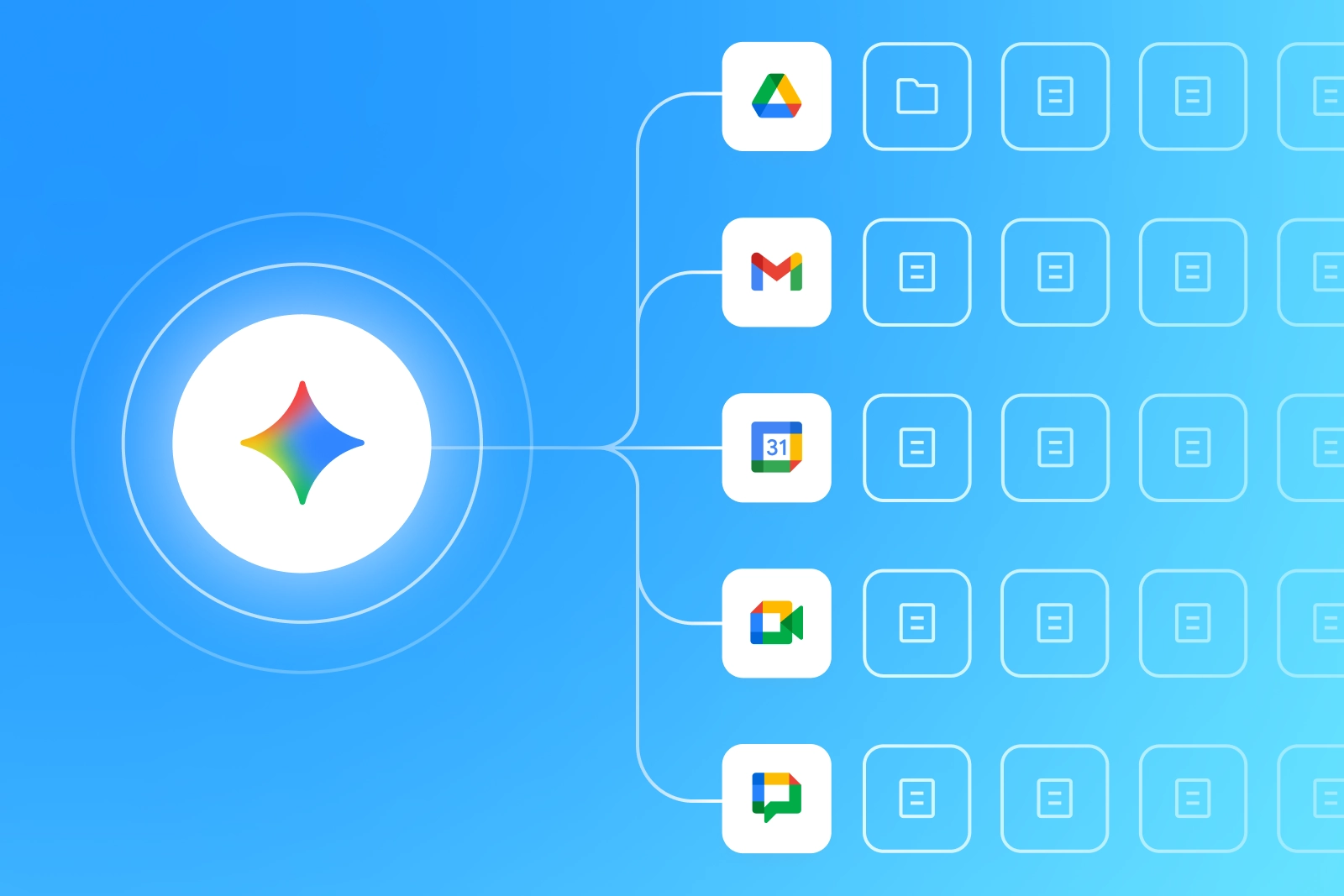

Google Gemini security refers to the combination of Google’s built-in protections and your own enterprise controls that keep data, users, and workflows safe when people use Gemini across web, mobile, and Google Workspace.
Google provides foundational safeguards such as strict data-use commitments, access-controlled retrieval from Workspace apps, and admin-level privacy settings that govern how user activity is stored and reviewed.
Enterprise accounts benefit from additional assurances: prompts and responses are not used to train the models, and Gemini only references content users are already permitted to access based on existing Workspace permissions.
Still, secure Gemini adoption requires more than Google’s defaults. Organizations must apply their own governance to prevent oversharing, restrict risky prompt activity, and ensure only approved users can run AI-driven actions.
This often involves tightening access controls, applying data protection rules, monitoring usage patterns, and configuring Gemini’s Workspace integrations so that retrieval and automation operate within defined boundaries.
Even with Google’s built-in safeguards, Gemini introduces new pathways through which sensitive business data can be exposed or misused. These risks stem not from the model’s internal mechanics, but from how employees interact with Gemini, how prompts shape its behavior, and how connected systems expand its access. The table below summarizes the core risk categories enterprises must account for when securing end-user Gemini usage:
Gemini’s behavior is influenced by the data it can reference inside Google Workspace. Because it can draw on any files a user is permitted to access, the structure and governance of the underlying data environment can impact security.
Long-standing Google Drive sharing practices, including broadly shared team folders, inherited permissions, and old link share settings, expand the data surface available to Gemini. Even if users never open the files exposed through these permissions, Gemini may still treat them as contextual inputs. This turns oversharing into a governance and visibility challenge.
Identity controls determine what Gemini can reference, but logs alone don’t show how Gemini uses that access. Since Gemini synthesizes content rather than performing discrete file actions, traditional API monitoring can miss where sensitive context appears in outputs. Effective security requires pairing identity controls with context-aware oversight.
The most reliable way to reduce Gemini-related exposure is to shrink the accessible data surface. Organizations need to identify broadly shared or sensitive content, correct misaligned permissions, and continuously monitor for new exposures. Tightening the data environment directly limits what Gemini can surface in responses.
Google provides several built-in security and privacy controls that determine how Gemini handles data across Workspace. These features form the baseline organizations rely on before adding their own governance layers.
1. Data Privacy and Sensitive Data Controls: Gemini follows Google’s enterprise data-use commitments. Prompts and responses from paid Workspace accounts aren’t used to train models, and admins can control whether Gemini can access certain Workspace apps or user data. Privacy settings also allow organizations to manage stored activity and restrict the flow of sensitive information.
2. Identity & Access Management: Gemini respects existing Workspace identity controls, including OAuth permissions, group-based access, and zero-trust policies enforced in Google Admin. Access to Gemini features can be restricted by user, group, or organizational unit, ensuring only approved users can run AI-driven actions.
3. Encryption Standards (At Rest and In Transit): All data processed by Gemini inherits Google Cloud’s encryption controls: TLS for data in transit and AES-256 for data at rest. These protections apply to prompts, responses, and any Workspace files Gemini references during retrieval.
4. Data Residency & Regional Policy Controls: Workspace admins can apply data region policies for supported content types, helping organizations meet geographic storage requirements. Gemini adheres to the same residency controls applied to the underlying Workspace data it may reference.
5. Logging, Audit Trails & AI Transparency: Gemini activity integrates with Workspace audit logs, allowing security teams to review usage events, administrative actions, and configuration changes. While output-level logging is generally limited to administrative events, organizations still gain visibility into feature access and policy settings at the admin level.
6. Regulatory Compliance & Certifications: Gemini for Google Workspace inherits Google’s core compliance frameworks, such as GDPR, HIPAA (where applicable), SOC 2, and ISO/IEC 27001, providing baseline assurances for data protection, privacy, and operational controls.
7. Alignment with AI Governance Standards: Google’s AI principles and documentation align with emerging frameworks such as ISO/IEC 42001 and the NIST AI Risk Management Framework. These standards emphasize transparency, accountability, and documented safeguards for responsible AI use.
Secure Gemini use requires a combination of access control, data protection, usage governance, and continuous monitoring. These practices help organizations prevent oversharing, reduce unnecessary exposure, and ensure Gemini operates within approved boundaries.
As Gemini becomes embedded in daily workflows, relying on manual oversight is not sustainable. In order to ensure safe LLM use at scale, it’s crucial to implement automated controls that detect misuse, surface risky behavior, and validate that Gemini operates within approved boundaries.
Gemini activity should feed into automated checking mechanisms that identify unsafe prompts, unusual retrieval patterns, or attempts to access sensitive data. Automated threat detection ensures that risky interactions, whether accidental or intentional, are flagged before sensitive content is exposed.
To identify deviations in how employees use Gemini, monitoring needs to extend beyond static logs. Anomalous patterns such as repeated failed retrievals, unusual prompt topics, or sudden interaction spikes can indicate potential misuse. Real-time alerting and response help security teams intervene before these anomalies lead to data exposure or policy violations.
Organizations can correlate Gemini-related events with broader security signals by connecting them to existing security infrastructure, such as SIEM, SOAR, and DLP tools. SIEMs support centralized monitoring, SOARs automate remediation workflows, and DLP systems help enforce rules around sensitive data. Integrations with these tools create a more complete view of AI-related risks across the enterprise.
Even with strong governance, Gemini-related security breaches can occur through misconfigurations, compromised accounts, or high-risk prompt activity. A defined response process helps organizations limit impact and restore normal operations quickly.
Security expectations vary across AI platforms, especially in how they handle data, integrate with enterprise systems, and expose information. The table below highlights the core differences organizations consider when comparing Gemini to ChatGPT, Claude, and Perplexity.
Gemini’s effectiveness and safety depend heavily on the quality of the underlying Workspace environment and the ability to monitor data exposure as it evolves. Opsin provides the visibility, continuous assessment, and AI-specific controls needed to secure Gemini usage across real-world enterprise environments.
Securing Google Gemini isn’t simply a matter of enabling built-in protections. It requires understanding how AI interacts with real organizational data, how users shape its behavior through prompts, and how Workspace configurations influence what Gemini can access.
As enterprises adopt Gemini across more workflows, the risks tied to oversharing, permission drift, and AI-driven automation demand stronger governance than traditional Workspace tools provide. By combining Google’s native safeguards with continuous monitoring, least-privilege enforcement, and automated detection, organizations can establish a reliable foundation for safe AI use.
Solutions like Opsin further extend that foundation by revealing hidden exposures, validating Workspace posture, and providing the real-time visibility and remediation capabilities needed to manage AI-specific risks. With the right controls in place, enterprises can unlock Gemini’s value while maintaining the security, compliance, and operational integrity required at scale.

Give users clear rules on what they can paste and let DLP enforce the rest.
• Provide examples of “never paste” items (tickets, PII, contracts, credentials).
• Use lightweight prompt-linting guidelines to reduce accidental oversharing.
• Pair training with DLP rules that block sensitive data before Gemini receives it.
Opsin’s prompt-risk examples for Gemini provide ready-to-use training material: Assessing Gemini Oversharing Risk.
Track prompt patterns and correlate retrieval anomalies with identity events.
• Flag repeated attempts to coerce Gemini into revealing broader Drive content.
• Detect prompts referencing “hidden,” “restricted,” or “summaries of everything.”
• Correlate Workspace spikes with authentication and OAuth activity for context.
For deeper adversarial testing guidance, see Opsin’s research on AI threat models: AI Security Blind Spots.
Use managed Gems with restricted data access and clear behavioral boundaries.
• Require Gems to use predefined instructions and scoped retrieval sources.
• Block unmanaged or personal-account Gems from accessing corporate assets.
• Continuously audit Gem metadata, integrations, and retrieval scopes.
Opsin provides continuous Gem discovery and governance: Gemini Use Case.
Opsin continuously maps and scores exposure to shrink Gemini’s retrieval surface.
• Highlight overly broad folder inheritance and aged link-shares.
• Surface high-risk content accessible to large groups or external accounts.
• Recommend least-privilege corrections aligned to Workspace IAM rules.
Learn how Opsin detects and remediates oversharing at scale: Ongoing Oversharing Protection.
Opsin feeds Gemini activity into AI-aware detection pipelines that catch risks traditional logs miss.
• Identify unsafe prompts, anomalous retrieval patterns, and emergent exposure paths.
• Trigger automated containment actions when Gemini interacts with sensitive data.
• Provide rapid forensic context such as prompt history and underlying Drive risks.
See Opsin’s AI-specific detection platform: AI Detection & Response.