Top 8 Microsoft Purview Alternatives for Data Security in 2026

Key Takeaways

Microsoft Purview has become a core component of many enterprise data security and compliance programs, particularly for organizations deeply invested in Microsoft 365 and Azure. Its strengths lie in native integration with Microsoft workloads, built-in sensitivity labeling, and foundational information protection and compliance capabilities.
Organizations running Microsoft-centric environments can use Purview to provide a solid starting point for data classification and policy enforcement. However, as enterprises move into 2026, several limitations are becoming more apparent. Most organizations now operate across a mix of SaaS applications, non-Microsoft cloud platforms, and industry-specific systems where Purview’s visibility and control can be limited.
At the same time, the rapid adoption of generative AI has changed how data exposure occurs. AI assistants can surface, summarize, and redistribute information users never explicitly viewed, dramatically expanding the impact of existing oversharing caused by broad permissions, legacy access, and identity sprawl. As a result, many security and governance teams are evaluating alternatives that offer broader cross-platform coverage, deeper insight into access and permissions, and GenAI-aware protections focused on end-user behavior.
Below, we examine the top 8 Microsoft Purview alternatives for data security in 2026, highlighting how each platform addresses modern enterprise data and GenAI security challenges.
8 Best Microsoft Purview Alternatives for Enterprise Data Security
The Microsoft Purview alternatives below address modern enterprise data security challenges across multi-cloud environments and GenAI-enabled workflows. Each solution takes a different approach to visibility, governance, and risk reduction based on how data is accessed and used.
1. Opsin Security
Opsin Security is purpose-built for enterprises facing data exposure and oversharing risks that are amplified due to the increased integration of GenAI in everyday workflows. Opsin focuses on file-, permission-, and identity-level visibility across Microsoft 365, Google Workspace, Teams, and other collaboration platforms.
A key differentiator is its GenAI-aware approach. As discussed earlier, AI assistants amplify existing oversharing by surfacing data users already have access to. Opsin correlates permission structures, file metadata, sensitivity labels, and classification context to understand the level of exposure.
It continuously identifies over-permissive files, legacy access, and risky sharing paths that AI tools can exploit, and then prioritizes fixes based on business impact. Opsin also monitors end-user and agent-driven AI activity to detect when sensitive data is being surfaced or propagated beyond its intended audience.
Strengths & Ideal Use Cases
- Cross-platform visibility beyond Microsoft ecosystems
- Reducing AI-amplified oversharing and permission sprawl
- Enterprises seeking to address AI-amplified exposure by fixing access and permissions
2. Varonis
Varonis is an automated data security platform that emphasizes data discovery and classification, data security posture management, and data access governance to reduce exposure at scale. It helps enterprises find sensitive data, understand who can access it, and continuously reduce blast radius by fixing misconfigurations and enforcing policies.
Varonis also positions AI Security as a capability, including coverage for Microsoft Copilot and ChatGPT Enterprise, with a focus on monitoring AI data access and supporting LLM data remediation. This makes it relevant for GenAI-era exposure reduction, especially when AI tools can surface data through broad or inherited access.
Strengths & Ideal Use Cases
- Automated discovery/classification plus posture improvement (auto-fixing risky misconfigurations)
- Continuous access governance to reduce blast radius and enforce policy
- Organizations adopting Copilot/ChatGPT Enterprise that need visibility into AI data access
3. OneTrust
OneTrust helps enterprises operationalize privacy, data governance, and regulatory compliance across complex, distributed data environments. Its strength lies in connecting enterprise-wide data discovery, AI-driven classification, ownership, and purpose-based policies to ensure data is used appropriately across business, analytics, and AI initiatives.
Rather than focusing on file-level exposure or access-path analysis, OneTrust emphasizes policy-driven governance and real-time enforcement. Organizations define data use policies based on regulatory requirements, consent, purpose, and sensitivity, and translate them into enforceable controls across data platforms.
OneTrust supports AI-ready governance by governing which datasets can be used, for what purpose, and under what conditions. While it does not monitor AI-driven data surfacing in end-user tools, it provides critical guardrails for compliant AI and analytics usage.
Strengths & Ideal Use Cases
- Purpose-based, policy-first governance
- Privacy and regulatory compliance enforcement
- Enterprises with mature governance programs
4. Collibra
Collibra is positioned as a unified governance stack for data and AI, built on a platform powered by active metadata. It brings together capabilities like Data Catalog, Data Governance, and Data Lineage so teams can standardize definitions, improve trust, and clarify stewardship across large, distributed data estates.
Instead of focusing on real-time end-user exposure monitoring, Collibra emphasizes governance workflows and policy execution at scale, including privacy management and data quality/observability. For access-oriented controls, Collibra Protect adds data access governance with classification and streamlined policy management across complex, multi-cloud environments.
Collibra supports responsible AI use by ensuring AI initiatives rely on well-governed, well-documented data assets, even though it does not track AI-driven data exposure directly.
Strengths & Ideal Use Cases
- Enterprise data cataloging and lineage
- Stewardship-driven governance and accountability
- Large organizations with a complex analytics ecosystem
5. Immuta
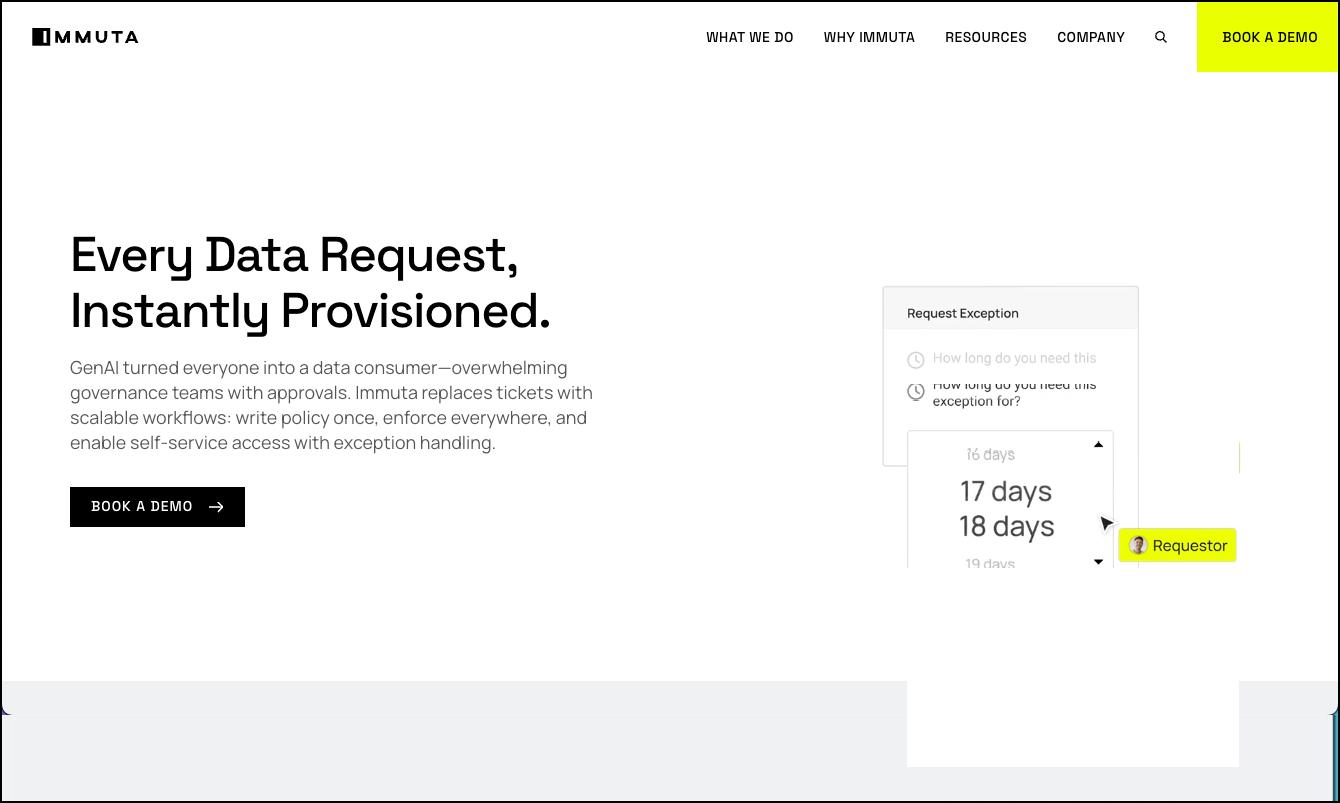
Immuta specializes in policy-based data access control for modern analytics and cloud data platforms. Instead of governing files or collaboration content, Immuta operates directly within data warehouses, lakes, and analytics environments to control how data can be queried and used.
Its core capability is dynamic, attribute-based access control, allowing organizations to enforce fine-grained rules based on user identity, role, purpose, and data sensitivity. This makes Immuta particularly relevant for regulated data environments using platforms such as Snowflake, Databricks, and BigQuery.
As GenAI and analytics converge, Immuta helps limit AI-related risk by ensuring that users and AI-driven workloads can only access data explicitly permitted by policy. While it does not monitor AI-driven data surfacing in end-user tools, it plays a key role in governing what data AI systems are allowed to access.
Strengths & Ideal Use Cases
- Fine-grained access control for analytics data
- Regulated and compliance-driven environments
- Policy enforcement for AI and data science workloads
6. BigID
BigID positions itself as a data security and compliance platform that delivers enterprise-scale data discovery and classification across cloud, SaaS, on-prem, and hybrid environments. Its core value is giving organizations a unified view of what data they have, where it lives, and what sensitive elements it contains, so teams can act on existing risks.
Beyond visibility, BigID emphasizes risk remediation and control: identifying security and risk issues, enabling data minimization and deletion workflows, and supporting reporting for audit and compliance needs. This makes it a strong Microsoft Purview alternative for organizations with large, distributed data estates that need consistent coverage beyond Microsoft-native services.
For GenAI initiatives, BigID also highlights AI security and governance capabilities to help teams discover and govern AI-related data and assets, and manage AI data risk, even if it’s not focused on monitoring AI-driven data surfacing inside end-user chat tools.
Strengths & Ideal Use Cases
- Enterprise-wide data discovery and classification
- Risk remediation, reporting, and compliance workflows
- Organizations with large, diverse data footprints
7. Nightfall
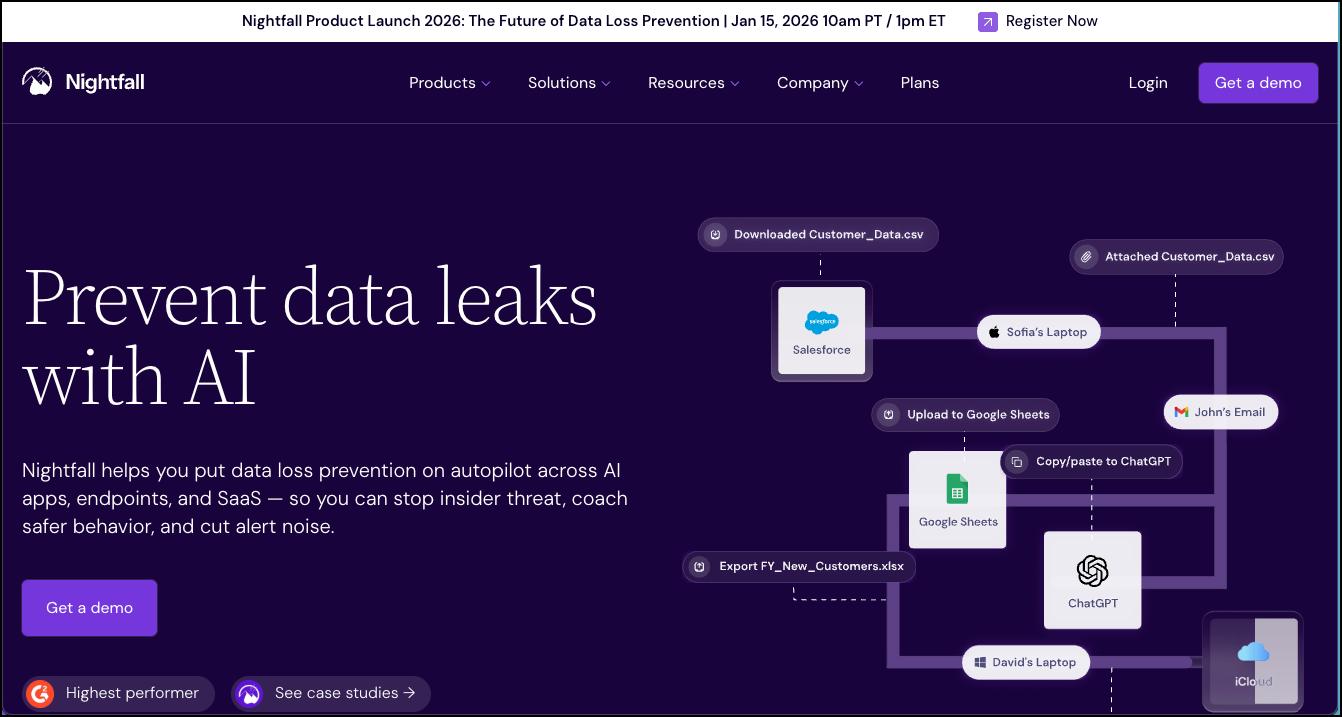
Nightfall focuses on preventing sensitive data exposure and exfiltration across SaaS, GenAI, and email, using an AI-native detection engine to identify regulated and confidential data (e.g., PII, financial data, source code) as it moves through modern channels.
Rather than emphasizing governance programs or permission modeling, Nightfall is built for real-time detection and response, monitoring, sharing, and transfer events, and triggering automated actions to stop leaks with fast time-to-value across the ecosystem.
For GenAI adoption, Nightfall explicitly targets “shadow AI” leakage by capturing prompts, copy/paste, and uploads into AI tools, classifying and blocking sensitive content before it leaves organizational control. It also offers Nyx, an agentic assistant in the console that helps teams investigate violations and get recommendations faster.
Strengths & Ideal Use Cases
- Real-time sensitive data detection across SaaS and GenAI channels
- Preventing user-driven leakage via prompts, copy/paste, and uploads
- Security teams prioritizing rapid response and automated enforcement
8. Securiti
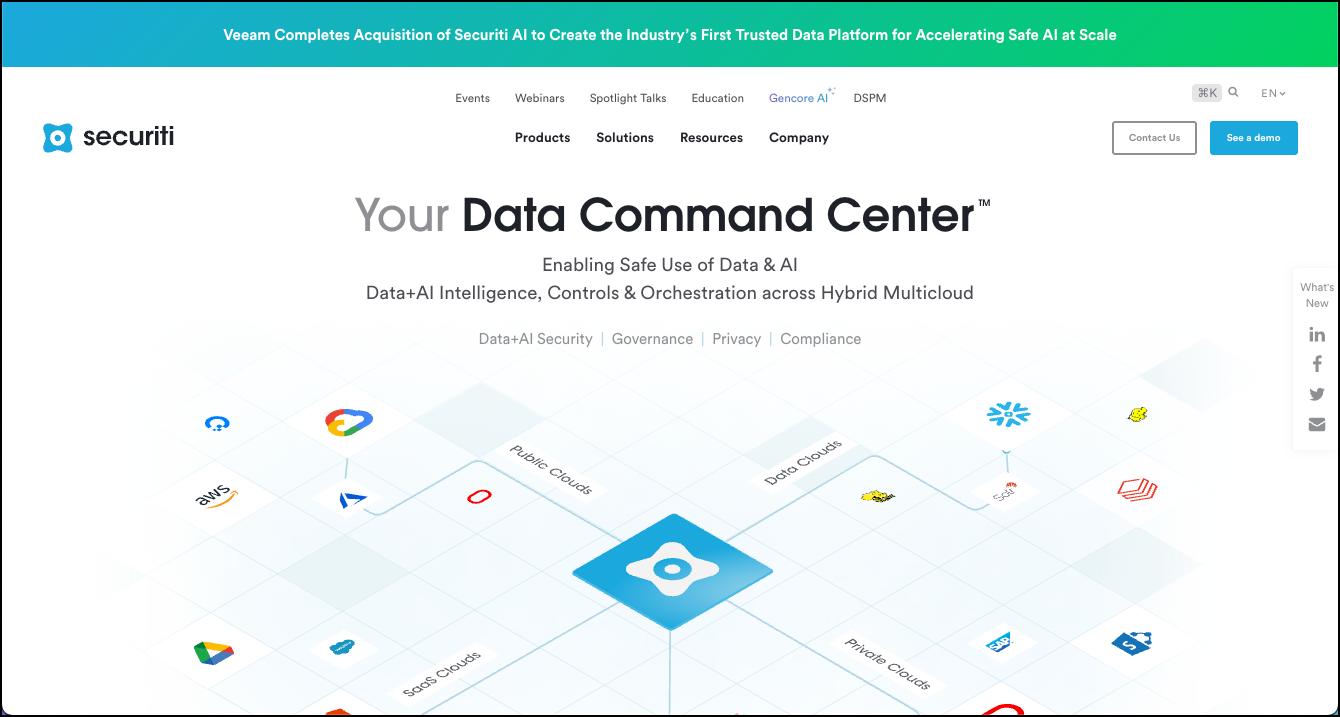
Securiti positions its platform as a “Data+AI” command center that combines DSPM, Sensitive Data Intelligence, and Access Intelligence to discover and classify sensitive data, understand who can access it, and reduce security and compliance risk across hybrid multicloud and SaaS environments.
Securiti.ai emphasizes centralized policy management and continuous controls across security and compliance use cases, supported by broad data discovery, cataloging, and visibility into access and risk posture.
For AI adoption, Securiti.ai extends into AI Security & Governance and Security for AI Agents and Copilots, plus Gencore capabilities like context-aware LLM firewalls to protect AI interactions (e.g., prompts, retrieval, and responses).
Strengths & Ideal Use Cases
- Unified Data+AI security posture and sensitive data intelligence
- Access intelligence plus policy-driven controls across environments
- AI governance and guardrails for agents, copilots, and GenAI apps
Microsoft Purview Alternatives Comparison
The comparison below summarizes how leading Microsoft Purview alternatives differ in their core capabilities, deployment models, and ideal use cases. It provides a quick way to assess which platforms align best with your data footprint, governance requirements, and GenAI risk profile.
Key Features to Look for in a Microsoft Purview Alternative
As organizations evaluate Microsoft Purview alternatives, certain capabilities consistently emerge as critical for managing modern data risk. The features below reflect what enterprises should prioritize when securing data across multi-cloud environments and GenAI-enabled workflows.
- Unified Visibility Across SaaS, Cloud, and Data Stores: Centralized insight into where enterprise data lives across collaboration tools, cloud platforms, and data environments, not just Microsoft-native services.
- Context-Rich Identity, Access, and Permission Intelligence: Clear understanding of who can access what data, how permissions are inherited, and where excessive or outdated access creates exposure.
- Data Classification Beyond Microsoft Ecosystems: Ability to recognize and use classification and sensitivity context across non-Microsoft platforms to support consistent governance decisions.
- AI & LLM Oversharing Detection: Visibility into how AI assistants and workflows surface, summarize, or redistribute data based on existing access, not just manual prompt activity.
- Automated Remediation and Policy Enforcement: Built-in workflows to reduce risk by tightening permissions, enforcing policies, or guiding corrective actions at scale.
- Real-Time Monitoring Across Files, Chats, Apps, and Workflows: Continuous awareness of how sensitive data is accessed and shared across day-to-day enterprise activity.
- Support for Multi-Cloud and Non-Microsoft Stacks: Native coverage for heterogeneous environments where data spans multiple clouds, SaaS tools, and industry systems.
How to Evaluate the Right Microsoft Purview Alternative
Selecting the right Microsoft Purview alternative requires evaluating how well a platform aligns with your actual data landscape and risk profile. The criteria below help security and governance teams assess coverage, scalability, and effectiveness as GenAI increases data exposure across the enterprise.
Why Opsin Is a Leading Microsoft Purview Alternative
- Cross-Platform Data & Access Visibility Beyond Microsoft Ecosystems: Opsin provides visibility into files, folders, and access permissions across collaboration platforms that extend beyond Microsoft-native services. This allows organizations to understand real exposure across Google Workspace, Slack, Teams, and other tools where sensitive data often resides outside Purview’s core coverage.
- AI-Aware Detection of Sensitive Data Oversharing Across Apps: As outlined earlier, GenAI amplifies existing oversharing rather than creating new exposure. Opsin is built around this reality, identifying how AI assistants surface data based on inherited permissions and legacy access across connected applications.
- Automated Permission Fixes Through Policy-Based Workflows: Instead of static reporting, Opsin helps teams move from insight to action by prioritizing risky files and access paths based on business impact. This enables targeted remediation that reduces exposure without requiring large, manual access review initiatives.
- Deep Context Into Identities, Access Paths, and Data Movement: Opsin correlates users, groups, permission inheritance, and file metadata to explain not just where data is exposed, but why. This context helps security teams trace how access propagates across teams, identities, and AI-enabled workflows.
- Lightweight Deployment Without Agents or Heavy Configuration: Designed for SaaS-first environments, Opsin deploys quickly without endpoint agents or complex infrastructure changes, allowing organizations to gain value and reduce risk with minimal operational overhead.
Conclusion
Microsoft Purview remains a strong option for Microsoft-centric environments, but the realities of multi-cloud adoption and GenAI-driven data exposure are pushing enterprises to look beyond native tooling. The alternatives covered in this guide reflect a broader shift toward deeper access visibility, AI-aware risk detection, and actionable remediation across diverse platforms.
For organizations prioritizing the reduction of AI-amplified oversharing, Opsin stands out by focusing on file-, permission-, and identity-level exposure and how AI assistants operationalize existing access. By aligning the right platform to actual data sprawl and GenAI usage, enterprises can move into 2026 with a more resilient and practical data security posture.


FAQ
How does GenAI increase data exposure without users explicitly sharing files?

GenAI tools surface data based on existing permissions, amplifying legacy access and oversharing rather than creating new exposure paths.
- Review broad group memberships and inherited permissions before enabling Copilot or Gemini.
- Test AI assistants with realistic prompts to see what data they can surface today.
- Prioritize reducing access sprawl instead of relying only on DLP or prompt filtering.
Opsin’s GenAI-aware oversharing analysis aligns with this model of AI-amplified risk.
What signals matter most when evaluating GenAI-aware data security tools?
Effective GenAI security requires understanding why data is accessible, not just that it was accessed.
- Correlate identity, group inheritance, and permission chains across SaaS platforms.
- Analyze how AI retrieval surfaces data users technically have access to, but rarely use.
- Track AI-driven access patterns alongside traditional human access paths.
How should enterprises balance governance platforms with real-time exposure reduction?
Governance defines intent, but exposure reduction determines actual risk in day-to-day workflows.
- Use governance tools to define ownership, purpose, and regulatory constraints.
- Pair them with exposure-focused platforms that detect and fix over-permissive access.
- Continuously reassess access as AI assistants change how data is retrieved and summarized.
Learn more about AI oversharing risks.
How does Opsin prioritize which oversharing risks to fix first?
Opsin ranks exposure based on business impact, sensitivity, and AI exploitability, not just volume of findings.
- Identify files with sensitive data that are broadly accessible via inherited permissions.
- Map which identities and AI tools can surface that data today.
- Focus remediation on high-impact access paths rather than blanket lockdowns.
This prioritization workflow is central to Opsin’s platform design.
How does Opsin support secure Microsoft Copilot rollouts without slowing adoption?
Opsin reduces Copilot risk by fixing access and permissions before AI surfaces sensitive data.
- Run pre-rollout exposure assessments to identify Copilot-visible oversharing.
- Remediate legacy and excessive access with targeted, policy-based fixes.
- Monitor post-deployment AI activity to catch new exposure paths early.
Customer outcomes show this approach enables safer Copilot adoption at scale.